Shoji: Japan's Room Dividers, Made Poetic
In Japanese architecture, shoji serve an important function: they divide rooms without ever fully enclosing them. A sliding door of wooden frame and washi paper filters light, views and cold, yet never blocks them completely. Diffuse daylight that warms a room without dazzling it: this is the principle of the shoji, which became an affordable feature of Japanese homes during the Edo period (1603–1868).
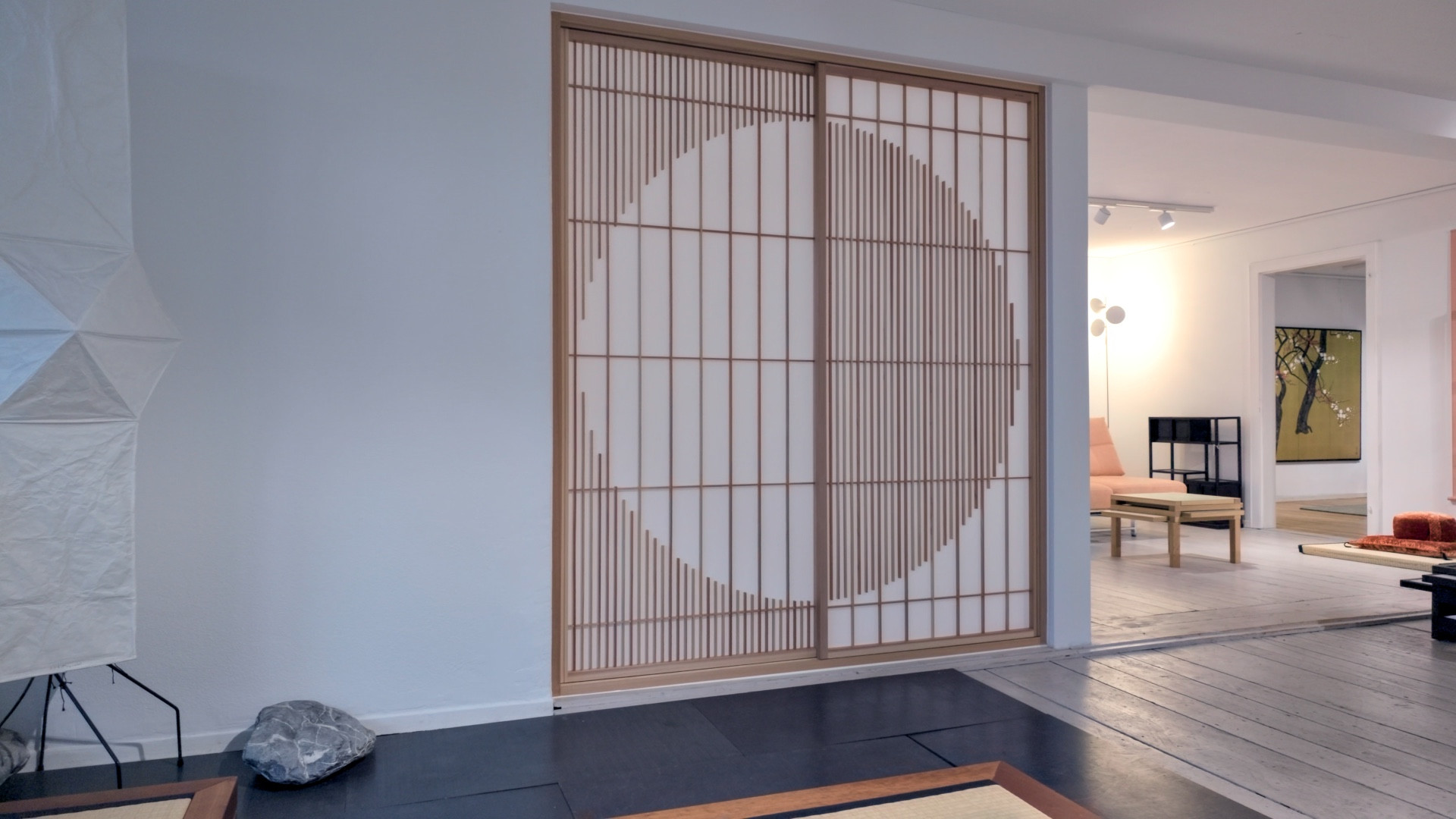
What a specialised manufactory in Japan makes of this is of an altogether different order. The uniform kumiko grid of the traditional shoji sliding door becomes a design element in its own right: shifted rectangles recall compositions from abstract painting. A classic grid is enriched by a fine, linear pattern.
Sun and Moon
How striking these patterns can be is evident in our showroom: «Sun» and «Moon», for instance, make light itself the motif – lit from behind, they glow like celestial bodies at twilight. Depending on whether it is morning or evening, daylight or deliberate backlighting, the effect keeps changing. These shoji can be used as room dividers, but they are equally luminous wall pieces that one never quite finishes looking at.
Made in Japan
Behind this work stands a Japanese manufactory from a region known for its abundant forests. As no two trees are alike, the craftsmen select each piece individually and work it in a way that brings out its particular qualities. For Sato, it was therefore a natural choice to add this manufactory to its range, whose shoji coax a delicate play of shadow from Japanese wood and daylight. Winner of the Good Design Award.
Each shoji is made to measure, and the range of patterns on offer is considerable. We are happy to advise you in person at Sato's shop. Guide price: The installation on display in our showroom (4th floor) costs CHF 4,900.

Related product
Shoji Japan | Consultation and ordering in our shop
Price: CHF 0
Shoji from Japan: traditional room dividers made of wooden frames and washi...